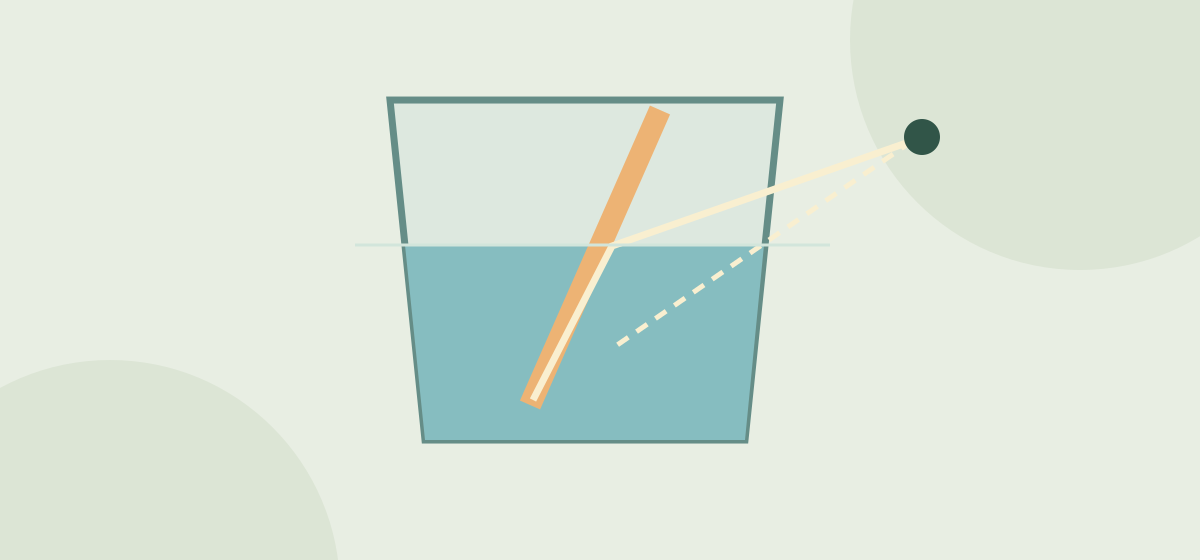
Put a straight straw into a glass of water and look from the side. At the waterline, the straw may seem to jump or bend. Lift it out and it is straight again. The change is in the route taken by light, not in the straw.
The eye receives two different sets of paths
Light from the part above the water reaches you along one route. Light from the submerged part passes through water and crosses boundaries before reaching your eye. Refraction changes the direction of a ray at such a boundary. The two portions can therefore appear misaligned even though they remain physically connected.
A ray diagram is a way to separate object and image
The Physics Classroom uses the broken-pencil example to show how a ray model accounts for apparent distortion. Trace the light that reaches the observer rather than drawing a straight line from the actual submerged point through every material. The backward extension of the arriving ray is not necessarily the location of the original point.
This is why “the water bends the straw” is the wrong description. The object, the path of the light and the apparent image are three different things. Keeping them separate turns a familiar trick into a useful model of seeing.
Try changing one condition
Keep the straw still and slowly move your head. Notice whether the apparent displacement changes. Then take the straw out, without bending it, and compare its shape. These observations help distinguish a view-dependent optical effect from a physical kink.
For a cleaner comparison, use a container with flat sides. A curved drinking glass introduces additional glass boundaries and lens-like distortions. If the submerged part also looks wider, do not assume that a single flat water surface explains every feature of the image.
Refraction depends on the path and angle at the boundary. Looking straight down is not equivalent to looking obliquely through a curved wall. A sketch should identify its viewing arrangement before being used to predict which way an image moves.
What to take away
The visible join at the waterline is a clue that the two portions are being seen through different optical routes. Instead of asking why the straw broke, ask where the light changed direction. That same habit—separating an object from the path by which we see it—helps explain many otherwise puzzling images.
Sources & further reading
References checked 2026-09-10. This is an adapted English edition, not an endorsement by the cited organizations.
Watch the original scene · English-language clip
Open on YouTube ↗Something needs correcting? Contact the editorial desk with the article URL and supporting evidence.


